Frequently Asked Questions
Your Title Goes Here
Your content goes here. Edit or remove this text inline or in the module Content settings. You can also style every aspect of this content in the module Design settings and even apply custom CSS to this text in the module Advanced settings.
What does it mean to be in a union?
To be in a union means you are part of a democratic organization of workers who collectively bargain with their employer to ensure fair treatment in the workplace.
What is collective bargaining?
Collective bargaining is a process, recognized and protected by federal law, that equalizes the power relationship between employees and their employer. It is a worker-led, democratic process where workers vote on major decisions. First, we vote to elect a bargaining team of our colleagues. Then, through our participation in town halls, surveys, and discussions, the bargaining team drafts a set of initial bargaining demands. GRID employees then vote democratically on whether to adopt those demands. The bargaining team would then negotiate with GRID management and come to a tentative contract agreement. During bargaining GRID workers will need to be involved in various ways: responding to proposals, deciding priorities, and above all taking action to ensure efficient negotiations that make meaningful improvements. Before that first agreement can go into effect, GRID workers must approve it in a majority vote. If we vote to ratify the tentative agreement, then it becomes a legally enforceable contract.
Without collective bargaining, GRID management has unilateral power to change our working conditions.
What is a collective bargaining agreement?
A collective bargaining agreement is a written contract between an employer and a union that represents a group of employees (bargaining unit) in a workplace. It typically addresses wages, benefits, such as health insurance and paid sick days and vacation, health and safety issues, procedures for addressing problems in the workplace, and any other issues of concern. What is in a particular collective bargaining agreement is up to the workers and the employer.
What is the process for forming a union?
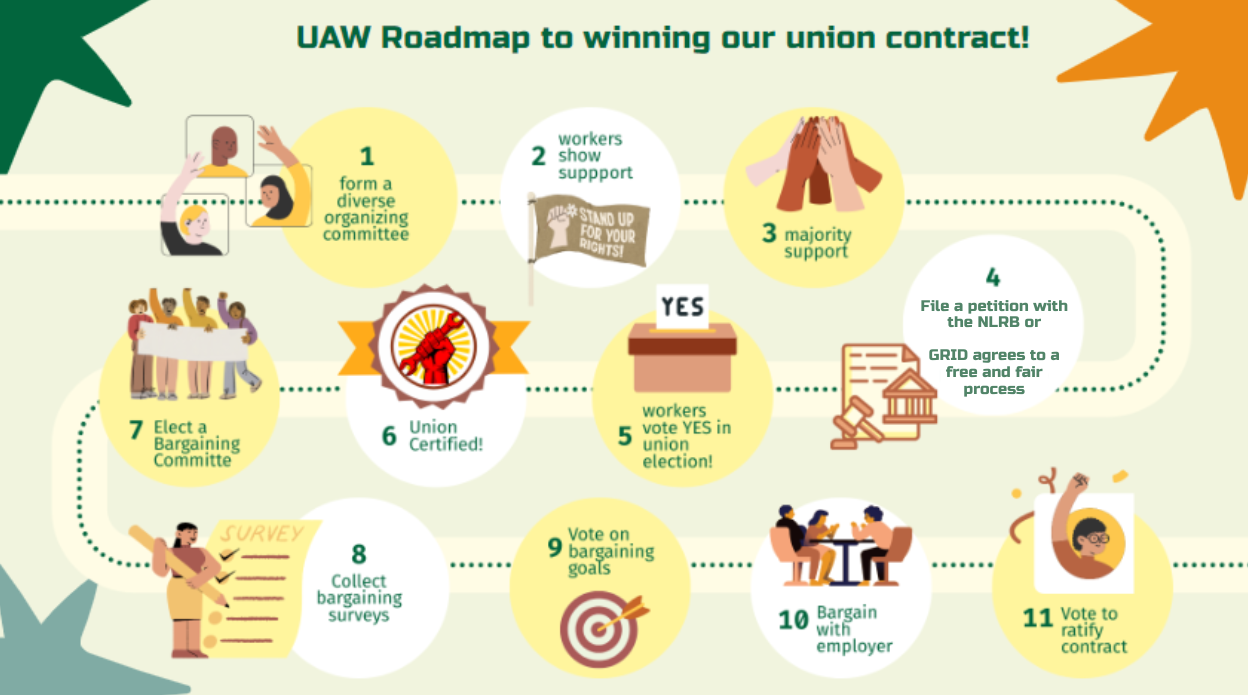
When a majority of workers sign cards authorizing GWA-UAW to be our union, we can either work out a voluntary recognition process with GRID or we can petition the National Labor Relations Board to hold an election. Once the union is recognized by GRID or certified in a NLRB vote, we can start bargaining for a first contract. The graphic below details the entire journey of forming and joining a union through a vote process, if necessary.
Who can be part of this union? Does it include "People Managers"?
Our goal is to include GRID employees who are not executive level. While the National Labor Relations Act places some limits on who may be included in an eventual bargaining unit (e.g. certain supervisors and managers), we encourage any GRID employee who is supportive of unionizing to sign a union authorization card to ensure that we have the strongest possible bargaining unit. That includes so-called “People Managers.”
What is a union authorization card and how do they relate to forming our union?
Union authorization cards are an essential part of forming a union. Signing a union authorization card indicates that you support forming a union and agree to representation by Grid Workers Alliance-UAW in collective bargaining. When a majority of workers sign cards authorizing GWA-UAW to be our union, we can either work out a voluntary recognition process with GRID or we can petition the National Labor Relations Board (NLRB) to hold a secret-ballot election. Once the union is recognized by GRID or certified in a NLRB vote, we can start bargaining for a first contract.
Does signing an authorization card guarantee that my position will be included in the bargaining unit?
Signing an authorization card does not guarantee that your position will be included. Once we seek formal recognition of our union, we hope GRID will agree to our proposed unit. If we are not able to reach agreement, the National Labor Relations Board or another agreed-upon neutral arbitrator would make a final determination about whether to exclude anyone from our proposed unit, based on our position, GRID’s input as the employer, and certain restrictions under U.S. labor law (for example supervisors and managers are generally not allowed to be part of the same bargaining unit as their employees).
What are dues?
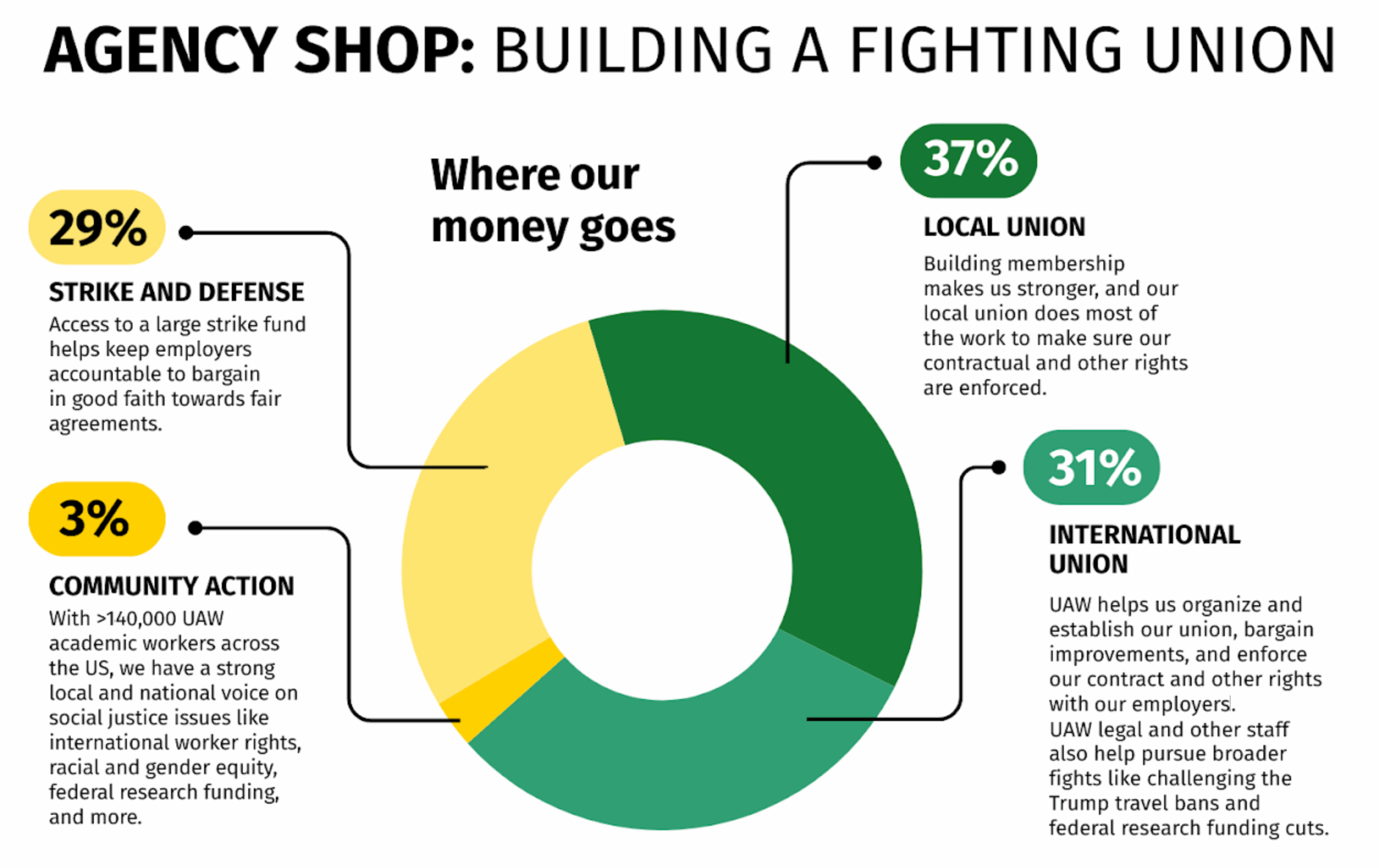
Members contribute monthly dues to support the work of their union. Dues at UAW are set currently at 1.44% of gross income. From bargaining contracts to enforcing them through the grievance procedure, union dues provide the resources used by locals every day. (Dues FAQ). No GRID employee will pay dues until workers vote to adopt a union contract and to pay dues.
What is a strike?
A strike happens when workers collectively decide to withhold their labor, usually with the intention of getting the employer to meet their demands. Strikes are typically used as a bargaining tactic during labor disputes or contract negotiations, although there are many types of strikes. Under the UAW constitution, a strike can only occur after a vote in which 2/3 of members voting authorize the union to call a strike.
I agree with the goals of unionization but aren’t there other ways for us to accomplish them?
While there are many ways for the GRID workers to engage with GRID management, forming a union means that GRID management will be required to negotiate a contract with us as equals. Unionizing also protects our right to take collective action free from retaliation, and, once we have a contract in place, will give us a mechanism to enforce the rights and benefits we bargain for in our contract. Many GRID workers have found that other efforts to make GRID a more equitable workplace have been under-resourced or not taken seriously by GRID management. By unionizing, GRID workers would have the power to more effectively implement improvements.
Will forming a union limit flexibility of work arrangements? Will a union contract instate universal policies that apply to everyone regardless of our particular contexts?
Since GRID workers will democratically decide what we choose to negotiate for, our proposals can reflect the various needs and interests of different workers within our bargaining unit. Union contracts can, and often do, include different terms and conditions for different groupings of workers based on whatever the bargaining unit voted to demand from the employer.
Why is the GRID Workers Alliance organizing with UAW?
While UAW began as an auto worker union, there are now over 100,000 higher ed workers in UAW, and tens of thousands of nonprofit employees in UAW. On the West Coast alone, UAW represents thousands of nonprofit employees, and is doubling in size in the nonprofit sector.
GRID Workers Alliance joining this movement is particularly critical at a moment when UAW’s focus on a just green energy transition is mission-aligned with ours. UAW has historically been one of the largest and most diverse unions in North America. By joining this movement, GRID workers will also gain political power to impact energy policy and funding decisions on the local, state, and federal levels.
How does the law protect the right of workers to form unions?
The National Labor Relations Act (NLRA) establishes the right of workers to organize and form unions, including signing union authorization cards. The law prohibits employers from restraining or coercing workers engaged in organizing activity.